The web isn't dying because of AI; it is drowning in a sea of templates. Platforms such as Squarespace, Wix and Shopify have made building sites easier than ever, but at the cost of creativity, originality and soul. If every website looks the same, does design still matter?
Let's get one thing straight: AI isn't the villain of web design. It is just the flashy scapegoat we have all decided to blame while quietly ignoring the real killer hiding in plain sight: templates.
No, not the innocent-looking starter kits we all downloaded in the early days. I am talking about the time-saving, monotonous, SEO-optimised, funnel-worshipping design sameness that has turned the open web into a tragic gallery of "Buy Now" buttons floating in beige rectangles.
If you are wondering why the web feels dead, lifeless or like a scrolling Groundhog Day of "hero image, tagline, three icons, CTA", it isn't because AI hallucinated its way into the design department.
We used to design websites like building digital homes: custom woodwork, odd hallways, surprising colour choices, even strange sound effects if you dared. Each one had quirks. Personality. Soul.
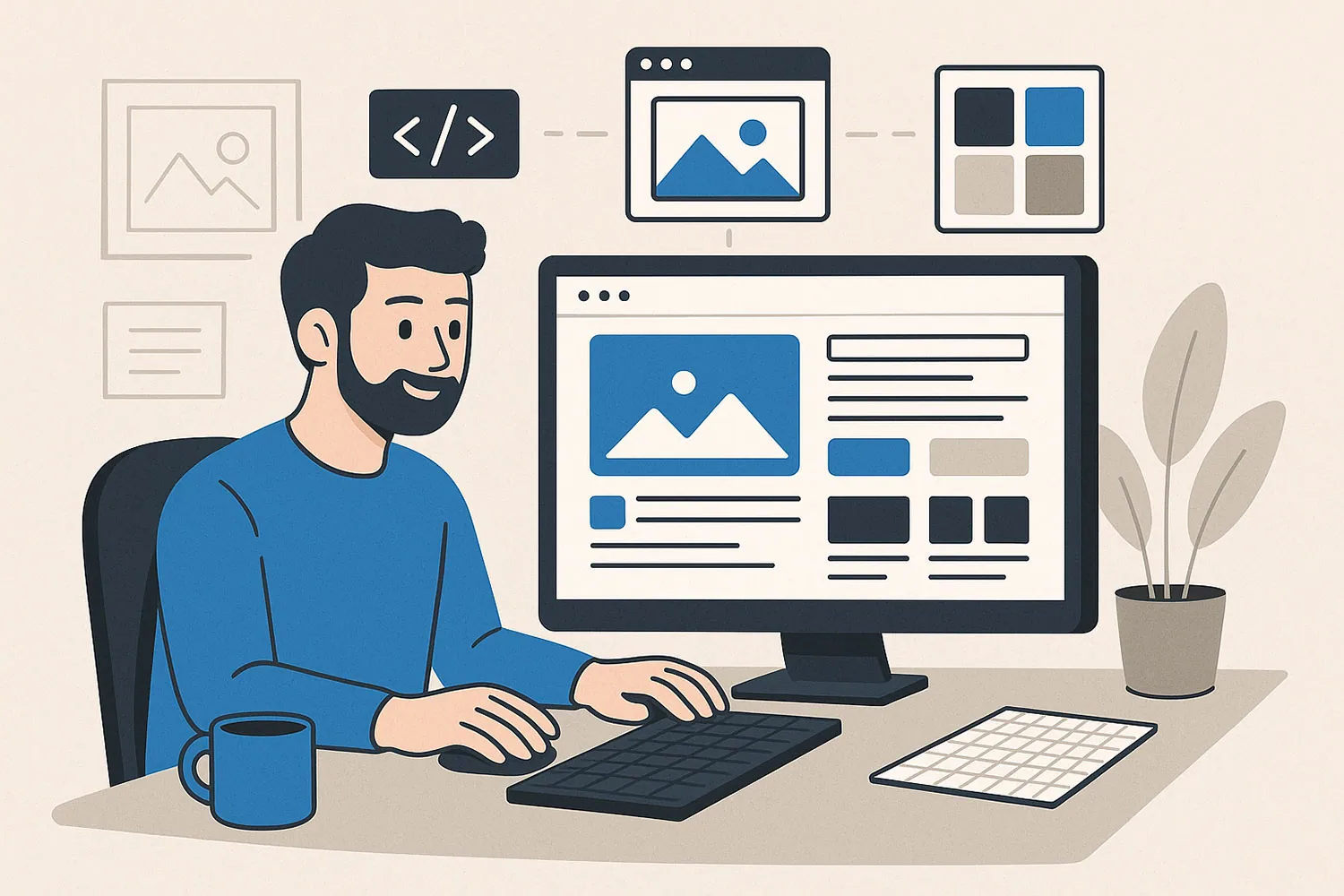
Now? Websites are just lightly re-skinned Shopify stores pretending to be brand experiences. Even portfolio sites, the sacred playground of creativity, have become sterile clones of one another: pastel backgrounds, sans-serif fonts and a strategically placed coffee-cup photo to humanise the horror.
What happened? Templates happened.
ThemeForest, Squarespace, Webflow, WordPress, thanks to their convenience, have created an ecosystem where differentiation isn't just optional but discouraged. Because originality breaks the template.
And breaking the template isn't good for conversions. Or SEO. Or the client's cousin Chad, who once read a Medium article about UX best practice.
Let's be realistic: clients no longer ask for design. They ask for "a site like this one". You know the kind. Clean. Animated. Smooth scrolling. "Modern." Which, in 2025, is just a euphemism for "I want what everyone else has so I don't have to think."
Templates didn't just simplify web development. They changed what people expect from a website.
Why hire a designer when you can drop your brand colours into a no-code template, add a few Lottie files and be done? The result isn't bad. It is worse than bad. It is forgettable.
And the worst part? We did it ourselves.
Everyone is busy blaming ChatGPT, Claude or Midjourney for killing originality. But AI didn't appear in our workflows by itself. It was trained on what we fed it. And what did we feed it?
Thousands of template-built, SEO-grown websites that all look the same. You can't tell a robot to innovate when your portfolio is made of duplicated grid layouts and gradient buttons copied from Stripe in 2017.
AI isn't the end of design. It is just an unavoidable mirror held up to a web we have standardised, sanitised and sold for $39 on a marketplace.
We fed AI the IKEA catalogue of the internet and expected Bauhaus in return.
Here is the hard truth nobody wants to say: the "website" as we knew it, handmade, custom and exploratory, is dying.
In its place we get web apps, not sites. Utility is the new creativity. The homepage has been replaced by the dashboard. The About page is now a Notion doc. And the experimental layout you were so proud of in 2014? It doesn't even pass Core Web Vitals anymore.
The web we loved was a canvas. The web we have now is a set of modular blocks optimised for user retention, ad revenue and frictionless e-commerce.
And maybe that was inevitable.
Design is no longer about creating a unique experience. It is about minimising bounce rates, hitting conversion targets and A/B testing whether button #4 should be 1.5em or 1.6em tall.
We are no longer designers; we are template tweakers, adjusting variables until the spreadsheet turns green.
The line between designer and product manager has blurred. You don't design a homepage; you optimise a funnel. You don't choose typography; you maintain "brand consistency". You don't make art; you massage business goals.
The average website today isn't designed; it is assembled.
It is a set of UX components picked from a pre-approved design system living in a Figma file so huge it has its own gravitational pull. We aren't paid to invent anymore. We are paid to make sure nothing surprises anyone. Web design has become corporate risk mitigation disguised as creativity.
Let's be fair: templates were never evil. They were meant to help us move faster, prototype better and democratise design. But like stock photos before them, templates have become the fast food of the internet: cheap, convenient and nutritionally empty.
And like fast food, they are addictive.
Why cook from scratch when a landing-page Big Mac is one click away? Why iterate towards originality when a template is "proven to convert"?
We built a world where good enough is the standard. Then we trained the next generation of designers to see it as the ceiling, not the floor.
If web design still has hope of surviving, it will need a rebellion. A deliberate rejection of efficiency in favour of expression. A refusal to conform to "what works" and a deeper dive into "what surprises". And honestly, that is hard to justify when you are working to tight deadlines for clients who have read too many SaaS landing-page teardowns.
The web artists (the weird ones, the brave ones, the ones still hand-coding CSS and animating things for no purpose other than joy) are out there. But they are no longer the mainstream. They aren't in Product Hunt's top 10. They are on the fringes, hiding on CodePen, personal blogs and obscure corners of the indie web.
If you want design to stay alive, stop feeding the template machine. Make weird things. Ugly things. Confusing things. Human things.
Because the web was never meant to be a distribution channel for sameness. It was meant to be a playground. A punk zine. A laboratory. A little chaotic. A little broken. But undeniably alive.
Let's stop blaming artificial intelligence for the death of creativity. AI didn't turn the web into a template; we did. We chose speed over originality. Conversion over character. Convenience over craft.
So yes, AI may finish the job. But don't forget who pulled the trigger first.
And if the death of web design is inevitable? Let it die weird.